
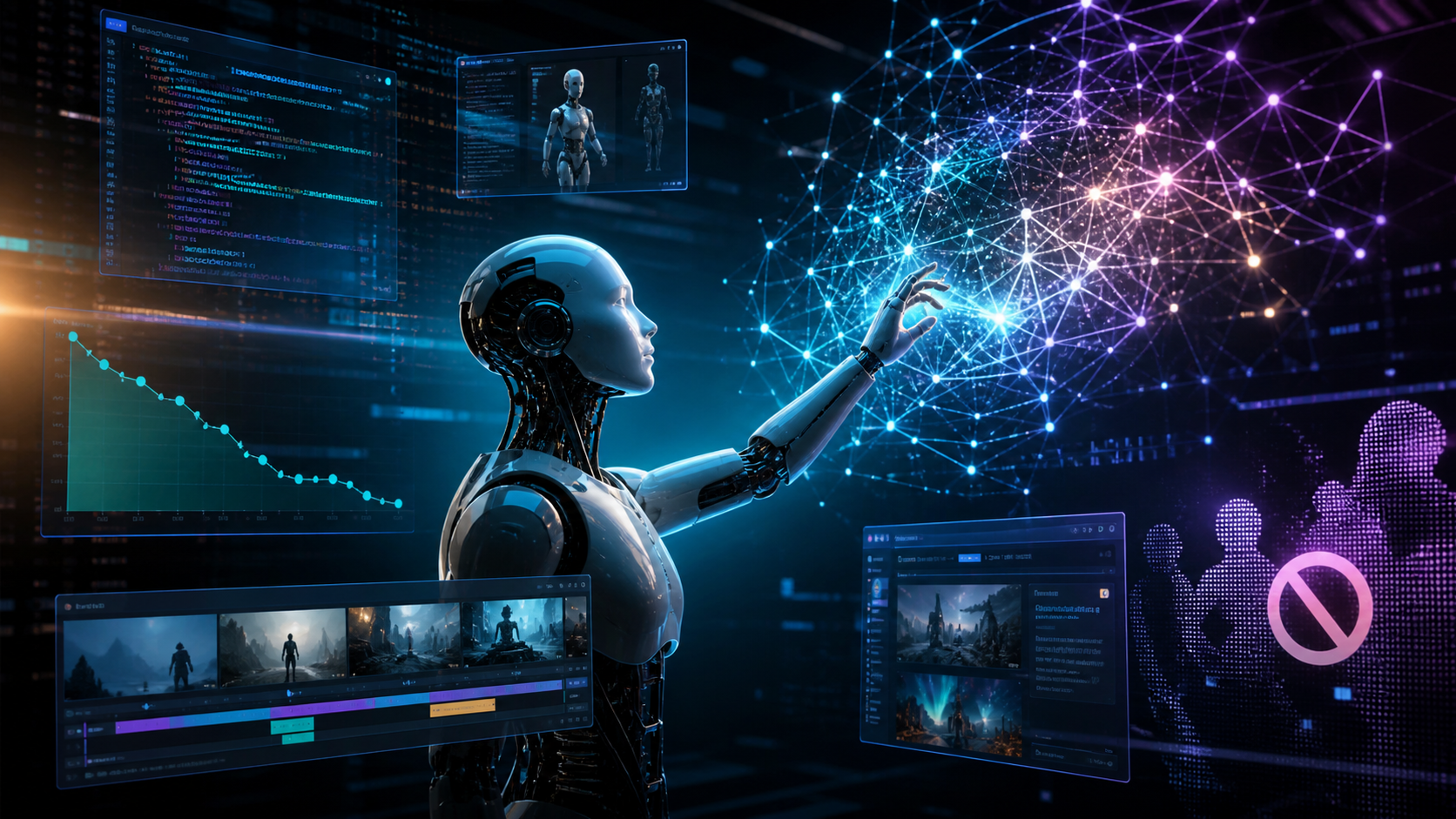
The past few weeks have delivered an unusually dense run of artificial intelligence announcements. The biggest developments are not simply larger models or flashier demonstrations. Together, they show powerful AI becoming cheaper, more autonomous and more deeply connected to browsers, workplaces, creative tools and physical robots.
That shift comes with a warning. Product launches often arrive wrapped in ambitious marketing, while online roundups compress roadmaps and demonstrations into claims that sound like finished products. Here is what has been confirmed, what it means and which claims still need caution.
## OpenAI pushes the price war forward
OpenAI's GPT-5.6 family includes Sol, Terra and Luna. The headline-grabbing change came when OpenAI reduced the API price of GPT-5.6 Luna by roughly 80 percent and Terra by 20 percent. The flagship Sol model was not discounted by 80 percent, a distinction missing from some summaries.
Lower inference prices change which AI services are economically practical. Coding assistants, research tools and support systems can process more requests before costs become prohibitive. The cuts also pressure Anthropic, Google, DeepSeek and other providers to compete on efficiency as well as benchmark results.
Cheaper tokens do not automatically produce better answers. Developers still need to test accuracy, latency and tool reliability for their own workloads. The larger story is that advanced capability is moving toward prices previously associated with lightweight models.
## Gemini gives humanoid robots whole-body control
Google DeepMind's Gemini Robotics 2 is one of the most consequential demonstrations. The system moves beyond controlling isolated robot arms and focuses on coordinated whole-body movement, including walking, reaching, crouching and manipulating objects.
DeepMind says its models combine perception, language, planning and action. This could make robots more adaptable than machines built around narrowly programmed motions. A robot could interpret a natural-language instruction, reason about its surroundings and recover when part of a task fails.
The demonstration should not be confused with mass deployment. Hardware costs, physical reliability, safety testing and training data remain substantial barriers. Nevertheless, whole-body control shows foundation models moving rapidly into physical machines.
## Browser agents start doing the clicking
Google is also integrating Gemini Spark with Chrome. Spark is designed to perform longer, multi-step tasks through an active browser session instead of merely explaining what a user should do. Access currently depends on account type, subscription and region.
Browser agents could compare products, organize research and complete repetitive online tasks. They also operate close to private messages, payment pages and sensitive account settings. Users should review permissions and retain confirmation steps for consequential actions instead of treating autonomy as a substitute for supervision.
## LinkedIn pushes back against AI slop
As technology companies automate creation, LinkedIn is addressing automation's low-quality output. The company says it is reducing distribution of generic posts and automated comments that add no original perspective. LinkedIn reported that its early system correctly identified generic material 94 percent of the time during initial testing.
This is not a blanket prohibition on AI-assisted writing. LinkedIn says people can use AI to refine language, but posts should still express the author's knowledge and experience. That distinction may influence other platforms: assistance can be welcome while industrial-scale engagement bait is not.
## Workspaces are being redesigned around agents
Perplexity Projects combines research threads, files, instructions and Computer tasks inside persistent workspaces. Tasks inherit project context, reducing the need to repeatedly provide the same background.
Jack Dorsey's Block has launched Buzz, an open-source collaboration platform that places people and AI agents in shared team conversations. It is positioned as an alternative to parts of Slack and GitHub, supports different AI models and can be self-hosted. Buzz remains early-stage, so teams should assess its security and workflow limits before migrating.
Replit is pushing software creation in the same direction. Its tools can turn a written description into a website or application, provide visual editing and publish quickly. Calling that a finished production site “in one click” overstates the result. Authentication, accessibility, security, data handling and maintenance still demand review.
## Video generation advances alongside copyright concerns
ByteDance's Seedance 2.5 expands AI video creation using scripts, images, audio and video references. Longer clips and stronger creative controls make the system more useful for storyboarding, advertising and independent production.
The same capabilities deepen copyright and identity concerns. A technically impressive video may still misuse protected characters, performers' likenesses or source footage. Generation quality is advancing faster than industry agreement about licensing and disclosure.
## DeepSeek keeps cost pressure on the market
DeepSeek V4 Flash has gained attention for capable reasoning and coding at very low prices. Its efficiency supports the idea that useful AI does not always require the most expensive flagship model.
However, labels such as “the cheapest major AI model” can expire quickly. DeepSeek pricing has changed, and third-party hosts offer different rates. Buyers should compare current input, output and cache pricing together with uptime, privacy rules and task-specific performance.
## Viral claims that require stronger evidence
Alibaba's Qwen Code supports autonomous subagents, parallel work and durable scheduled tasks, but the claim that a Qwen model coded independently for 16 consecutive days needs better primary documentation.
Meta's Muse Spark has documented coding improvements, but calling it a direct Claude Code replacement goes beyond Meta's confirmed positioning. OpenAI has reported meaningful progress in research mathematics, yet its own First Proof review acknowledged that one proposed solution initially considered likely correct was later judged incorrect.
NVIDIA has announced computing hardware intended for orbital environments. That is different from saying SpaceX and NVIDIA already operate a completed AI data center in space. A roadmap, demonstration, partnership and operating product are not interchangeable.
## AI is becoming infrastructure
The strongest theme is not a single benchmark. AI is entering the infrastructure of everyday computing: browser sessions, team channels, software projects, media pipelines and physical robots. At the same time, falling model prices make continuous agent activity affordable to more organizations.
That combination will create useful products and plenty of noise. The winners will not necessarily be those making the loudest claims, but those pairing lower costs and greater autonomy with dependable verification, clear permissions and genuine human value.
See an error? Read our corrections policy or email [email protected].