Makers Gear Up for Accelerated Drone Shootout Using Bambu Lab Derivatives
Three international teams are vying to top the 657.59 km/h battery-powered quadcopter record, relying on Bambu Lab's new H3C and H2C 3D printers.

Three teams of makers are converging to challenge the 657.59 km/h battery-powered remote-controlled quadcopter record, utilizing hardware from Bambu Lab's expanded H-Series lineup. The challengers include the current record-holders, Cape Town duo Luke and Mike Bell, aerospace engineer Ben Biggs, and MIT mechanical engineering student John Xu.
Guinness World Records mandates specific constraints for this category, prohibiting tiltrotors and commercially manufactured models. Competitors must fly fixed-rotor prototypes on two-way courses to average wind speeds. The current benchmark has risen sharply, moving from 480 km/h in 2024 to 626 km/h in late 2025. This rapid ascent indicates an environment driven by private engineering iteration rather than established aerospace agencies.
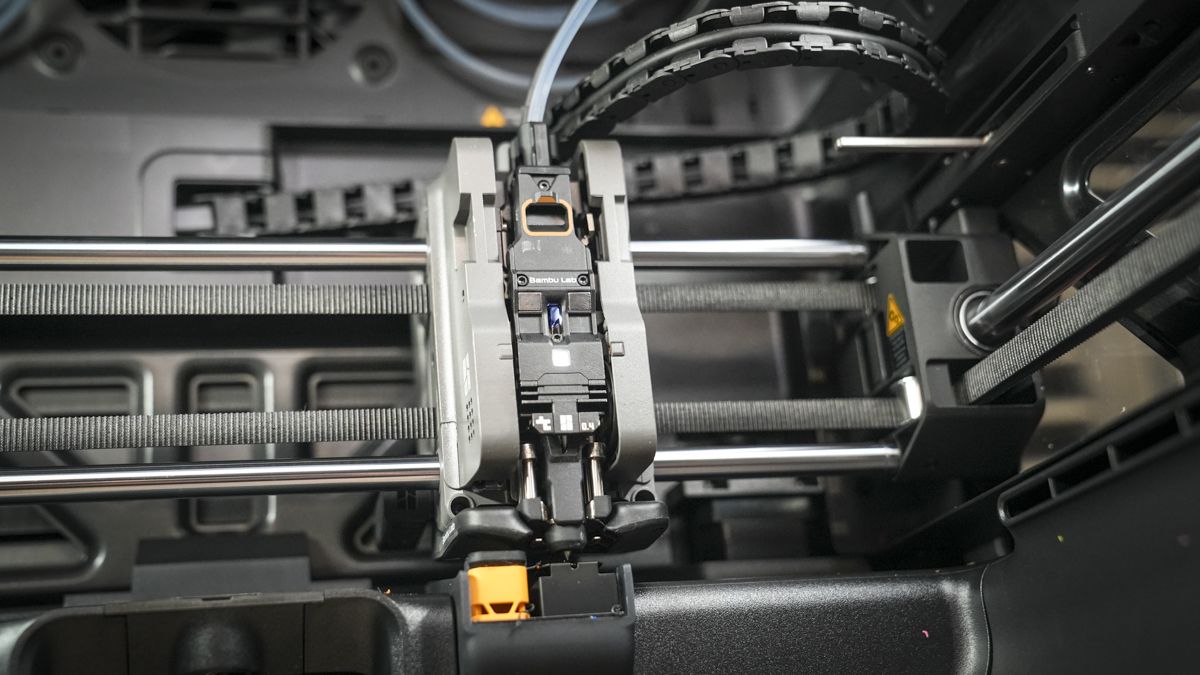
Buoying the technical effort is the "Let's Make It Fund," a Bambu Lab initiative providing up to $300,000 in grants. The program selects projects aligned with the company's strategic goals. The specifications of the available printer fleets—the all-new H3C and the H2C with the Vortek system—are integral to these builds. The H3C features nine independent hotends capable of 350°C temperatures and tool-swapping in six seconds, though the mixed-nozzle experience is reportedly still maturing. Meanwhile, the H2C utilizes the Vortek system for six interchangeable hotends, receiving an Editor's Choice review for performance despite a premium price point.
Ben Biggs has established unofficial velocities exceeding 680 km/h on downwind passes, offering raw performance advantages over the Bells. However, Biggs has previously faced certification hurdles due to the logistical absence of professional observers for these unofficial runs. Meanwhile, the identity of John Xu appears thin in the public domain; public records of his speed runs are limited to data released by Bambu Lab, classifying him as a significant unknown factor.
The logistical and environmental challenges remain the primary ceiling. Biggs's verified runs were hampered by scheduling and observer availability rather than physics. Additionally, the contested setting requires calm conditions, specifically late spring in Cape Town, as the local geography was critical to the Bell's previous titles. The H2D printer was also utilized by the Bells to print the V4 airframe as a one-piece multi-material construct in PETG, PA6-CF, and TPU.
The event places Bambu Lab's newest hardware—which went on sale November 3—directly in the high-performance simulation arena for makers. The partnership highlights the drive to validate the capabilities of desktop manufacturing in extreme environments.
Sources and further reading
See an error? Read our corrections policy or email [email protected].