Most Philippine firms unsure they can catch a hijacked AI agent, Cisco survey finds
A Cisco survey of 8,000 security professionals across 30 markets reports that 59% of Philippine organisations are very confident they can detect and respond to a compromised AI agent, while 93% dealt with a business-disrupting cyber incident in the past year.

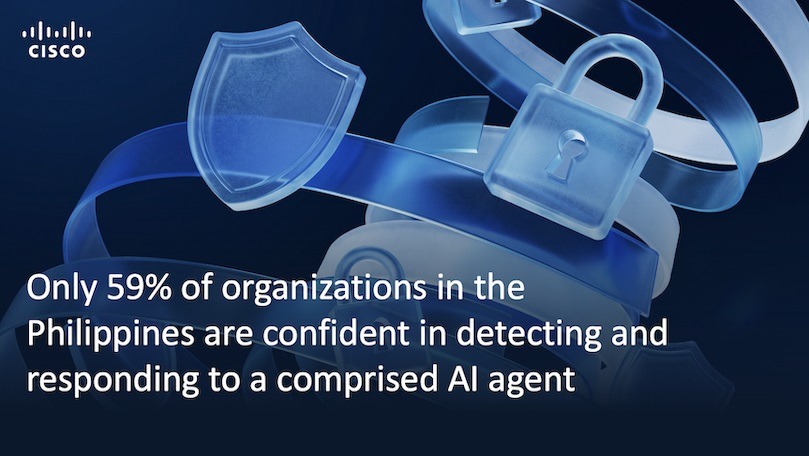
Only 59% of organisations in the Philippines say they are very confident they could detect and respond to a compromised artificial intelligence agent, according to a Cisco report released on October 19 and first detailed by Newsbytes.PH.
The findings come from Cisco's "Relentless Defense Report," a double-blind survey of 8,000 security professionals across 30 markets run in April and May 2026. The study scored organisations on security coverage, response speed and operational friction.
The wider picture is not reassuring. Ninety-three percent of Philippine respondents said their organisation had weathered a material cyber incident that disrupted business in the previous 12 months. Nearly half reported involvement in an attack that used AI.
Silos and data gaps slow response
The survey points to organisational problems as much as technical ones. Just 41% of Philippine respondents said their security, networking and IT teams work as one unit with shared visibility and tools.
Data handling is also a drag. About 32% said they spend more time gathering and reconciling data across systems than handling threats, and 37% said important insights get missed because data is inaccessible.
Reporting lines to leadership appear strained too. Fifty-three percent said their security metrics are too technical to win over executives, 28% struggle to translate business metrics into something that can shape decisions, and 13% have no consistent way to measure security performance.
Cisco Philippines managing director Zaza Soriano-Nicart framed the challenge around operational agility rather than tools alone, saying security has to be built into how organisations work and that silos must come down so decisions can be made quickly, according to the report.
AI adoption is uneven
Filipino security practitioners are largely positive about AI's effect on their work. More than nine in ten reported at least a 25% improvement in threat detection and response through AI, and more than a third said the technology substantially cut their workload.
More than half of organisations have deployed AI-powered security capabilities extensively. That enthusiasm thins in security operations, where only 42% have extensively deployed AI agents for investigation work — a function where such tools could relieve team pressure. Concerns about exposing data, compromised systems and third-party handling are cited as brakes on adoption.
Local scores ahead of global average
Seventeen percent of Philippine organisations landed in Cisco's top-performing category, the "Relentless Defenders," roughly double the 8% global figure. The average Philippine score was 70 out of 100.
Globally, top performers were more likely to have coordinated security teams and consistent controls covering AI agents and non-human identities. Among organisations that raised security spending, 71% of Relentless Defenders reported fewer security incidents, against 39% of other organisations worldwide.
What it means for the region
The Philippine results describe a familiar Southeast Asian pattern: decent confidence in AI-assisted defence, paired with fragmented teams and data that is hard to reach when it matters. For technology businesses serving local enterprises, the survey suggests demand may shift toward integration and governance work — shared tooling, agent controls, and metrics executives can act on — rather than more standalone detection products.
The confidence gap around compromised AI agents is worth watching as agent deployments expand, since agents act with delegated authority and can be harder to monitor than conventional software. The survey measures perception, not incident outcomes, so it cannot show how often detection actually failed.
Figures and quotations are drawn from Newsbytes.PH's reporting on the Cisco report. Cisco commissioned the study, and its top-performer category and scoring framework are its own.
Sources and further reading
See an error? Read our corrections policy or email [email protected].
Continue reading

GAC Philippines Brings 'Front Seat Faces' Fan Activation to PBA and UAAP Games

Apple HomeView Smart Display Launched with Siri AI