GL.iNet Fortify Review: Merging ExpressVPN with Open-Source Firmware
The GL.iNet Fortify delivers high-speed VPN tunneling but relies on aging Wi-Fi 6 hardware and lacks a user-friendly mesh system.

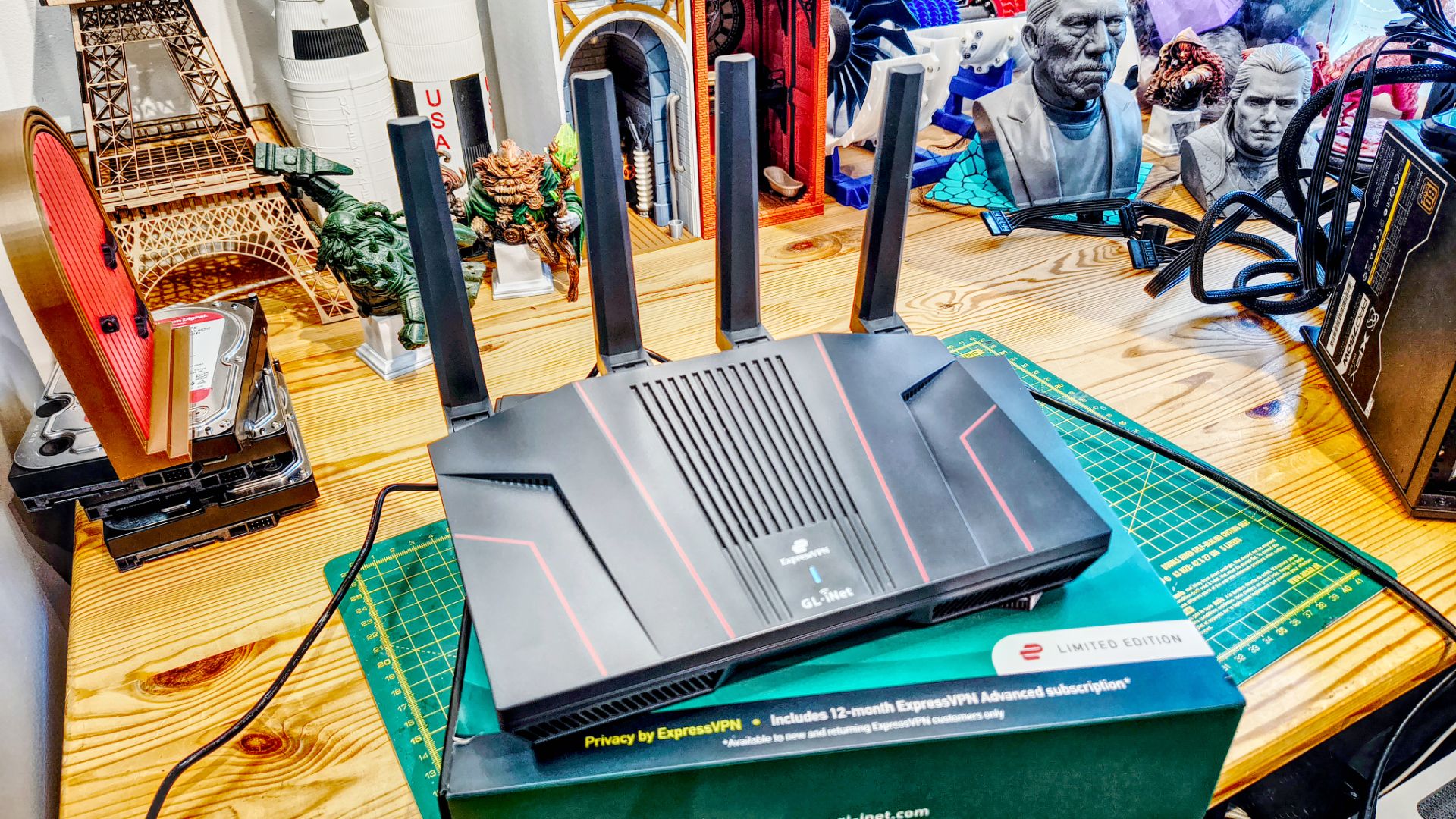
The GL.iNet Fortify serves as the successor to ExpressVPN’s previously retired Aircove, swapping a closed ecosystem for a partnership with the open-source router manufacturer GL.iNet. This collaboration results in a dual-band AX6000 router that integrates ExpressVPN services directly into the operating system. Performance metrics from vendor testing indicate WireGuard throughput can reach 900Mbps, with OpenVPN DCO capable of nearly 880Mbps. These figures suggest the device alleviates the processing bottlenecks often found in older VPN-specific hardware.
A key differentiator for the Fortify is its suite of built-in networking tools. Users gain access to AdGuard Home for system-wide ad blocking, Tailscale for secure remote access, and ZeroTier for virtual networking without requiring custom client installations. The device also supports dual WAN failover and includes a USB 3.0 port. Testing shows the USB transfer speeds remain consistent with the port specification, reaching approximately 90MB/s without the throttling sometimes seen in other routers.
Despite the software depth, hardware limitations exist. The router sits on the Wi-Fi 6 standard rather than the newer Wi-Fi 7, which limits maximum bandwidth on high-frequency bands. Hardware ports present a practical compromise, with only two 2.5GbE ports available—one labeled as WAN. This leaves a single high-speed connection for local devices like NAS servers on a modern home network.
The user interface supports advanced configurations, such as LuCI, the standard OpenWrt administration dashboard. However, initial setup interactions with the OpenWRT 21.02 codebase create friction, specifically regarding Access Point mode, which requires navigating to a backend menu rather than offering a simple toggle switch. Furthermore, while the router supports other VPN providers, ExpressVPN’s proprietary Lightway protocol is unavailable at launch.
In terms of value, the Fortify includes a 12-month subscription to the ExpressVPN Advanced plan. The base unit begins at $199.99, though promotional pricing has previously lowered this via voucher codes. With the underlying hardware being the Flint 2, a comparison analysis suggests a slight premium is charged for the VPN bundle, appealing to users who need to route traffic for smart devices that lack standalone VPN application capabilities.
Sources and further reading
See an error? Read our corrections policy or email [email protected].