Meta Adds Opt-Out for Smart Glasses Visual Data Used in AI Training
Meta now lets smart glasses owners stop their visual data from being used for AI training, but opting out may disable some features and human review remains possible for other data.

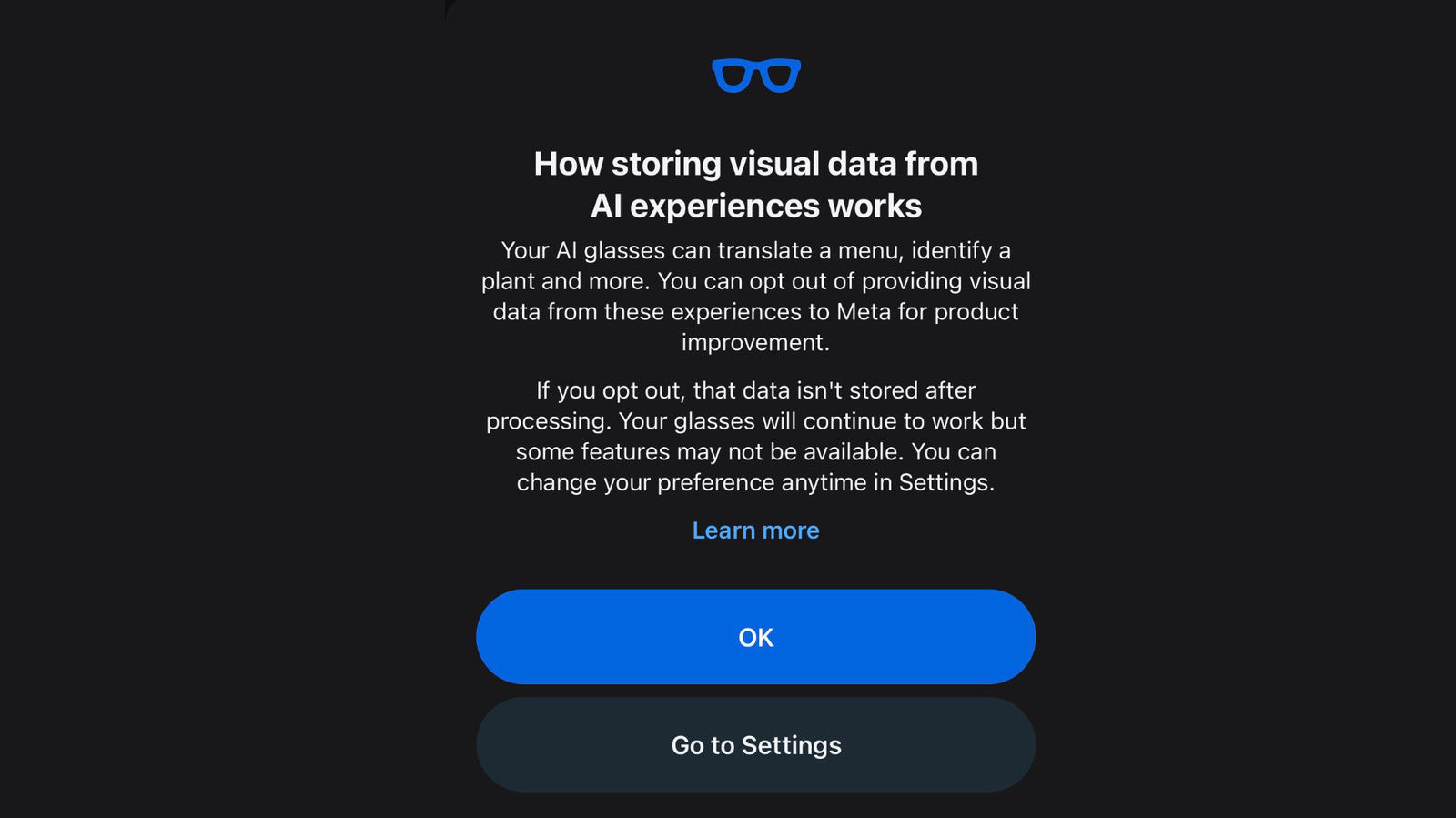
Meta has begun rolling out a setting that lets owners of its smart glasses prevent visual data collected during AI experiences from being used to train the company's AI models, according to Engadget.
The option is available in the Meta AI app, and the company is notifying glasses owners through a pop-up. According to the notification, if a user opts out, that data is not stored after processing.
The setting can be found by navigating to the glasses settings, selecting "Meta AI," and scrolling to "store visual data from AI experiences." The glasses must be out of their case and connected to a phone to change the setting. Owners with multiple pairs need to repeat the step for each pair.
Meta warns that opting out may prevent the use of certain features, including "visual reminders," such as looking at an object and asking Meta AI to remind the user to buy it later. Engadget notes it is unclear whether other features are affected.
Alongside the setting, Meta published a help center article that provides more detail on how visual data is used. The article explicitly states that human review is possible. The company says that when users engage AI experiences on the glasses, such as asking about something they are looking at or using Live AI, Meta stores the resulting visual data and may use it to power glasses features and improve products. This includes training and improving AI models, which may be automated or manual (human).
According to Meta, the stored visual data is limited to what is collected while using certain AI features, including Live AI. The company says visual data does not include photos and videos captured with the glasses when the capture LED is on.
The introduction of this opt-out follows broader scrutiny of how technology companies handle data from always-on devices. For smart glasses, the distinction between data captured during AI interactions and media captured by the user is important because the two streams are handled differently under Meta's policy.
For owners who want to limit how their visual data is used, the opt-out provides a clear control. However, the trade-off is potential loss of convenience features, and the human review possibility remains for data that is still collected if the user does not opt out, or for other data categories not covered by this setting.
Engadget's report does not clarify whether the opt-out applies retroactively to previously collected data, whether it affects all AI features or only some, or how users can verify that their data has not been stored after processing. It also does not specify which regions are receiving the setting first or whether it will expand globally.
Those details matter because the setting is rolling out gradually. Until Meta provides more specifics, users should treat the opt-out as a control that affects future data within the described scope, not necessarily a complete block on all data use.
The update gives users a new level of control, but it also highlights the underlying data practices that made the control necessary. For now, the change is a meaningful step for privacy-conscious owners, but its practical effect depends on how many features require the data and how transparent Meta is about the remaining human review process.
Engadget reported the rollout and the help center details.
Sources and further reading
See an error? Read our corrections policy or email [email protected].