
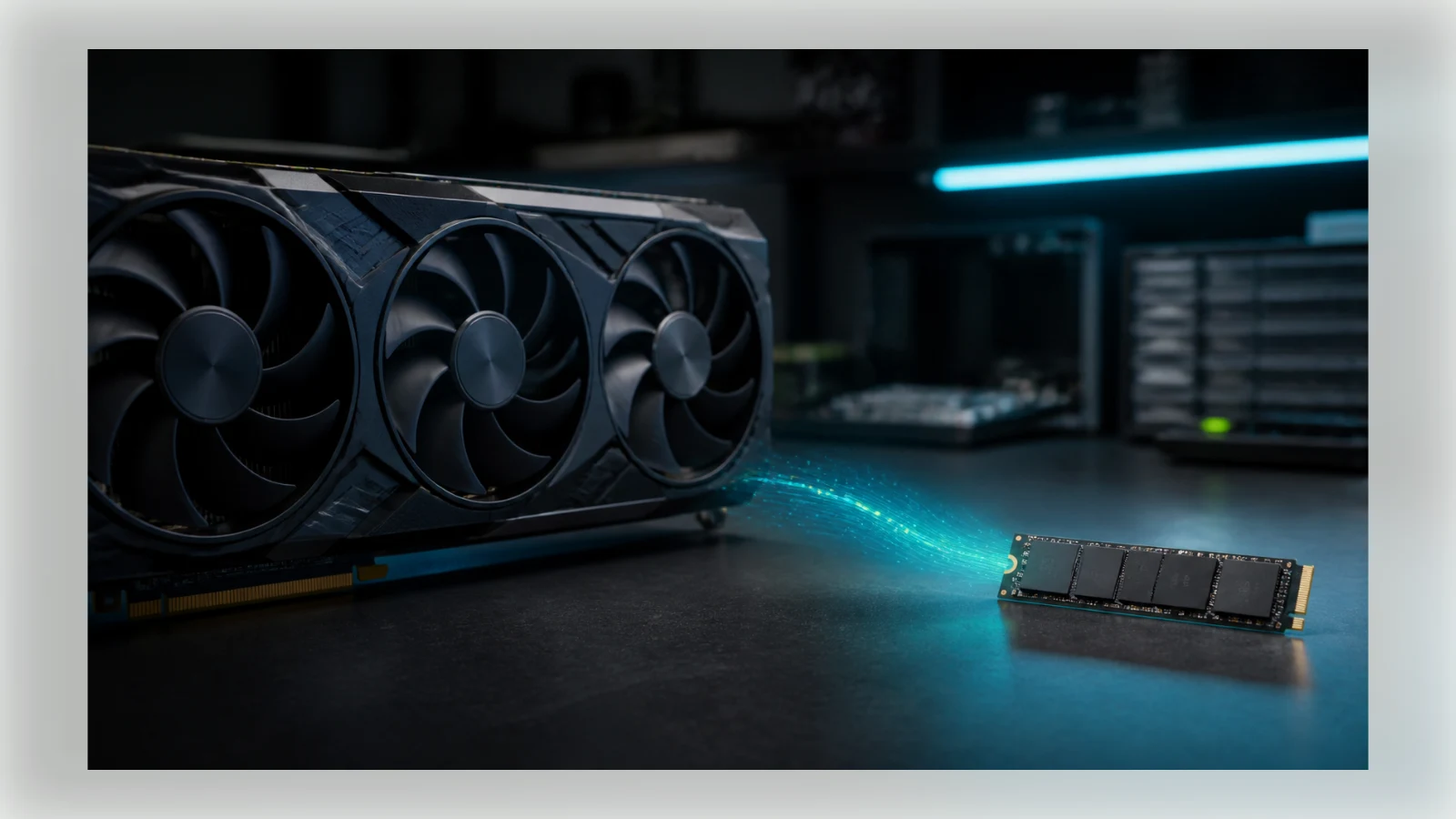
A claim that NVIDIA is developing a way for GeForce graphics cards to use an NVMe solid-state drive as backup video memory is spreading quickly on X. The idea has attracted attention from PC gamers and AI users who regularly encounter the limits of a graphics card’s onboard VRAM.
The posts describe a system that would page data from a fast SSD into GPU memory when a workload exceeds the card’s available VRAM. Supporters say it could help large games or local AI models continue running without an immediate hardware upgrade. Critics argue that an SSD would be far slower than dedicated graphics memory and could become another compromise used to justify GPUs with limited VRAM.
The important qualification is that NVIDIA has not publicly announced this reported GeForce feature. Technomalist could not find an NVIDIA product announcement, driver note or developer document confirming that consumer graphics cards will treat SSD capacity as additional VRAM. The trending discussion should therefore be treated as an unconfirmed claim rather than an announced product.
Why the idea sounds believable
NVIDIA already has technologies that move data efficiently between high-speed storage and a GPU. RTX IO is designed to deliver compressed game assets from NVMe storage to GPU memory with minimal staging in system memory. It works with Microsoft DirectStorage and lets the GPU handle decompression, reducing CPU overhead and improving asset-streaming performance.
NVIDIA also offers GPUDirect Storage for professional and data-center systems. That technology enables a direct data path between local or remote storage and GPU memory, avoiding an unnecessary bounce through the CPU. These are real foundations for faster storage-to-GPU transfers, but neither technology means that an SSD becomes equivalent to VRAM.
Dedicated VRAM offers much higher bandwidth and much lower latency than even a fast NVMe drive. A storage-backed fallback could potentially reduce abrupt failures or severe stuttering when a workload exceeds available memory, but it would not deliver the same performance as having sufficient physical VRAM on the graphics card.
What about SSD wear?
Some users on X have raised concerns that frequent paging could shorten an SSD’s life. The effect would depend on how a proposed system was implemented. Reading game assets from an SSD is different from constantly writing temporary memory pages to it, and NVIDIA has not published technical details that would allow a reliable endurance estimate.
What to watch next
Confirmation would need to come through an NVIDIA announcement, GeForce driver documentation, an RTX IO update or a developer SDK. Details such as supported GPUs, operating-system requirements, application support and whether the feature targets games, AI workloads or both would also matter.
For now, the underlying storage technology is real, but the specific “SSD as extra GeForce VRAM” feature remains unconfirmed. The safest conclusion is that X has identified a technically plausible idea, not a product NVIDIA has officially promised.
See an error? Read our corrections policy or email [email protected].