
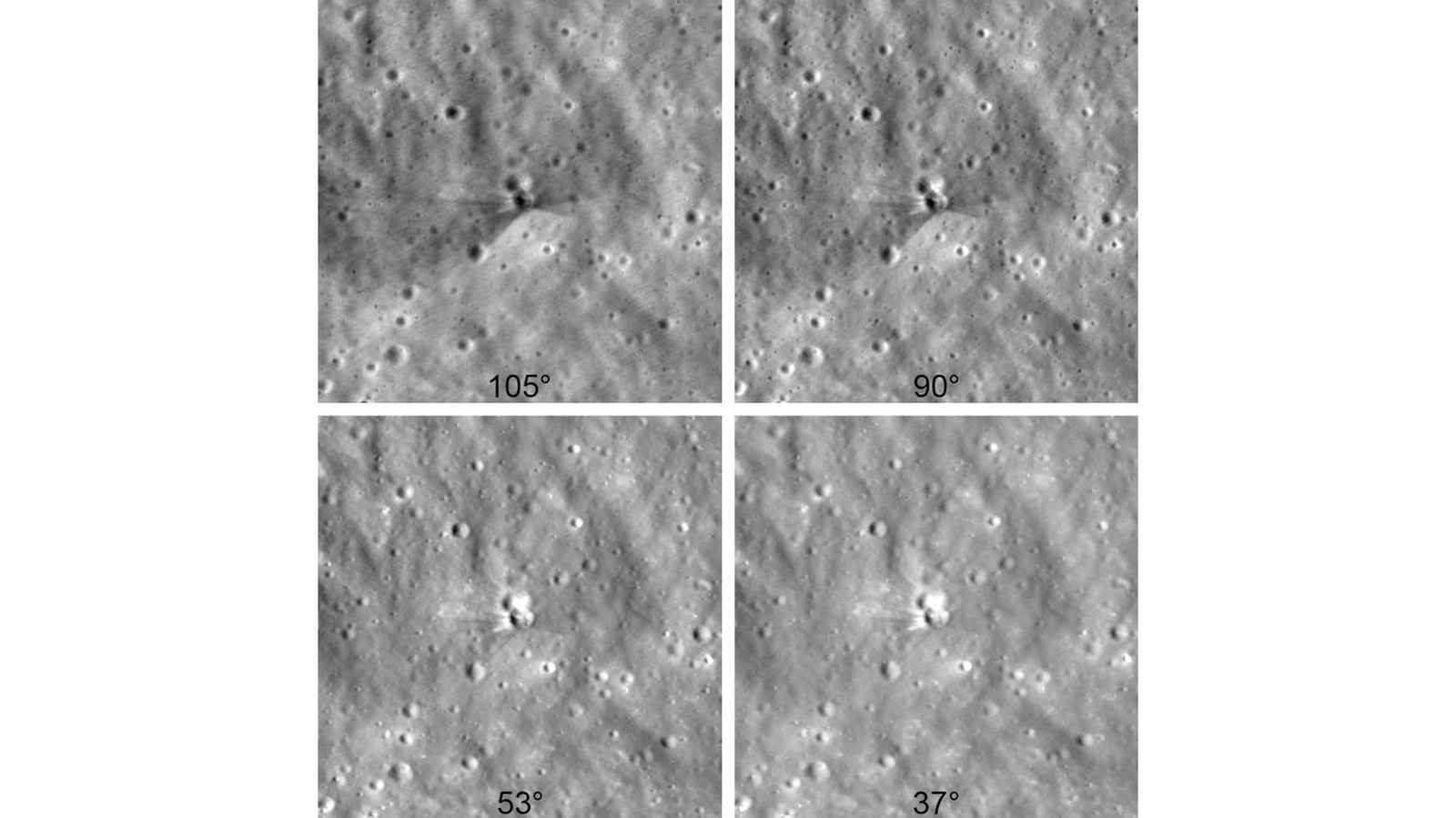
NASA has published images from the Lunar Reconnaissance Orbiter (LRO) showing a new crater on the Moon caused by the impact of a SpaceX Falcon 9 upper stage. The photographs were captured on August 11 and 12, less than a week after the rocket stage struck the lunar surface in the early hours of August 5, according to Engadget.
To photograph the site, NASA engineers rolled the spacecraft so its cameras pointed straight down as it passed 60 miles above the crater. They used LRO's Narrow-Angle Camera, which can resolve surface features as small as three feet across. Because the orbiter circles from pole to pole every two hours at one mile per second while the Moon rotates beneath it, NASA had to wait six days for the spacecraft and the crash site to align. The agency also released before-and-after images on its official website.
The new photos show the crash site from multiple angles. A darker streak radiates outward from the crater, made of older material from near the lunar surface—dust and rocks whose color and composition have been altered by long exposure to solar wind and cosmic rays. Lighter material near the rim came from deeper underground.
Independent astronomer Bill Gray first drew attention to the rocket's collision course in April. He used orbit-computing software to determine where and when it would hit, and he and his colleagues ran physics simulations that suggested the upper stage would not cause a large impact. The rocket stage was 39 feet long and 13 feet wide, weighing about 4,000 kilograms. It struck the Moon at 5,400 miles per hour, and NASA calculated that the resulting crater is 60 feet wide and 12 feet deep.
The Falcon 9 upper stage originated from the January 15, 2025 Blue Ghost mission, which carried two lunar landers into orbit. After using most of its fuel to deliver the landers, the stage could not return to Earth. Gravitational forces and solar activity eventually pulled it toward the Moon.
See an error? Read our corrections policy or email [email protected].