PhoneBot turns a cheap Android phone into a humanoid robot's brain and eyes
UCLA researchers have built an open-source humanoid that offloads sensing and computation to an ordinary smartphone, with hardware costs around $400 before the handset.

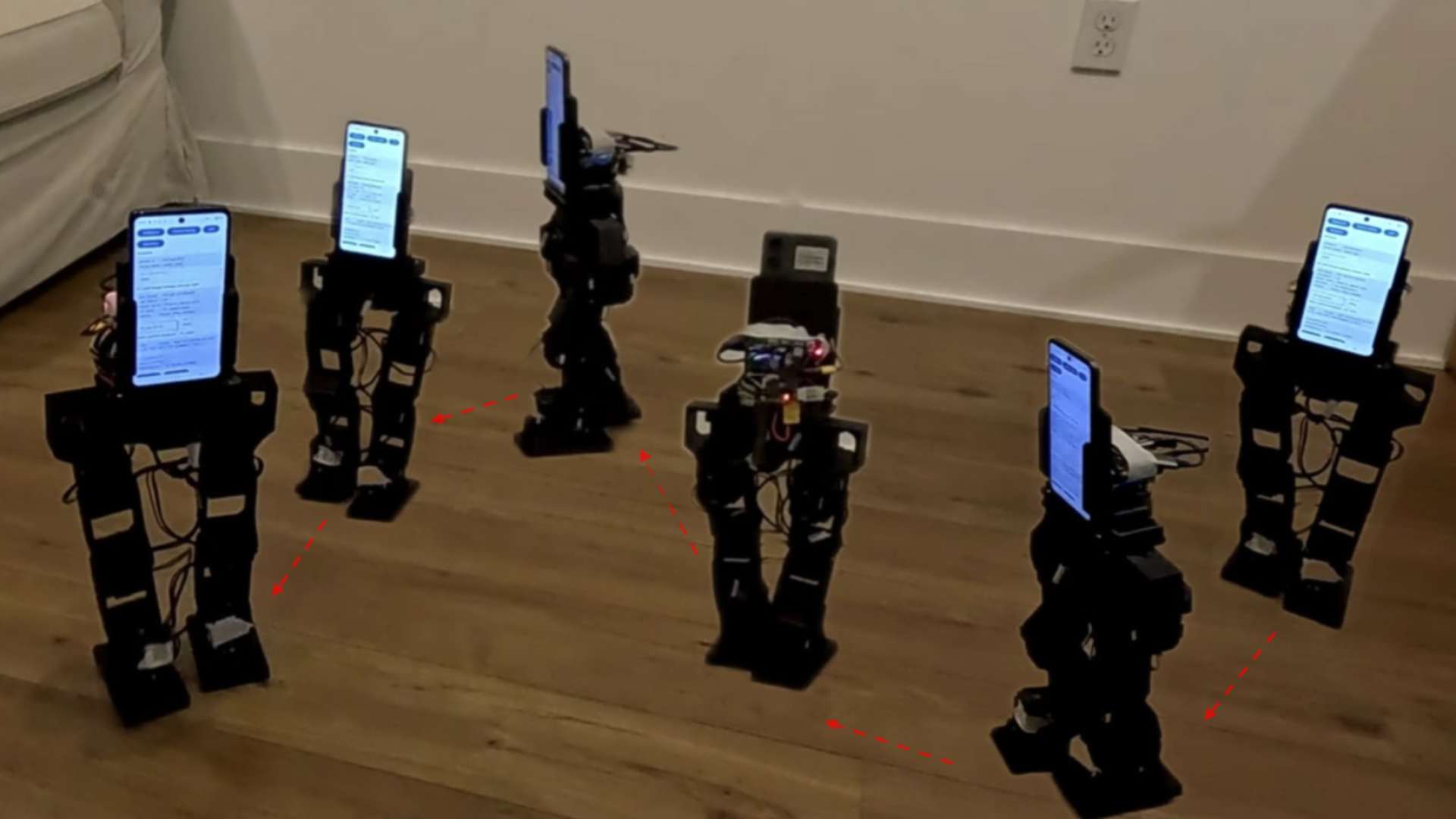
Researchers at UCLA have built PhoneBot, a small open-source humanoid that uses a smartphone for perception and computation instead of dedicated cameras, motion sensors and an onboard computer. TechRadar reports that the robotic hardware costs about $400, not counting the phone, positioning the platform as a lower-cost option for robotics research and maker projects. The project is described in an arXiv preprint, which was not described as peer-reviewed.
PhoneBot is 483 mm tall and weighs 1.8 kg. It uses 13 servo motors: six actuated joints per leg covering hips, knees and ankles, plus a joint that rotates the torso and the mounted phone. A separate computer inside the robot receives wireless commands from the phone over Wi-Fi and translates them into joint movements. The phone's camera handles person tracking and pose estimation, while its inertial measurement unit provides motion data used for balance and learned walking. Because the torso joint can turn the handset, the camera can face a person without the robot repositioning its feet.
The team tested four Android handsets: an Honor 9 from 2017 and three inexpensive phones priced at roughly $50 to $80. According to TechRadar, all four handled core functions such as motion sensing, walking control, visual detection and human interaction, though some features varied by model. The application runs locomotion policies through TensorFlow Lite.
The walking controller was trained with reinforcement learning in simulation. The researchers rewarded desired movement and penalized unstable posture and excessive motor loading. Early runs produced uneven gaits, with the robot favoring one leg; the team addressed this by adding mirrored training samples that teach corresponding left and right motions. Across five independent training runs, the reported joint-angle symmetry error fell from 0.254 radians to 0.003 radians in later evaluations. Left-right torque imbalance dropped from 0.205 to 0.034, and mechanical-power imbalance from 0.339 to 0.040.
Physical demonstrations included walking, getting up from a face-down position, and aiming the phone camera at people without continuously turning the robot's feet. The limitations are significant: low-powered servos restrict payload and reliable dynamic movement; the walking controller was trained on flat ground; the robot has no arms for manipulation; and uneven-terrain mobility remains unresolved.
The open-source design is aimed at researchers who want to reproduce the platform, swap components and study smartphone-based robotics. The reported cost and phone compatibility make PhoneBot interesting for labs and makers, but it is not a consumer product or an upgrade recommendation. Its value is as a testbed for inexpensive sensing and control—if the preprint's results hold up under broader review.
Sources and further reading
See an error? Read our corrections policy or email [email protected].