
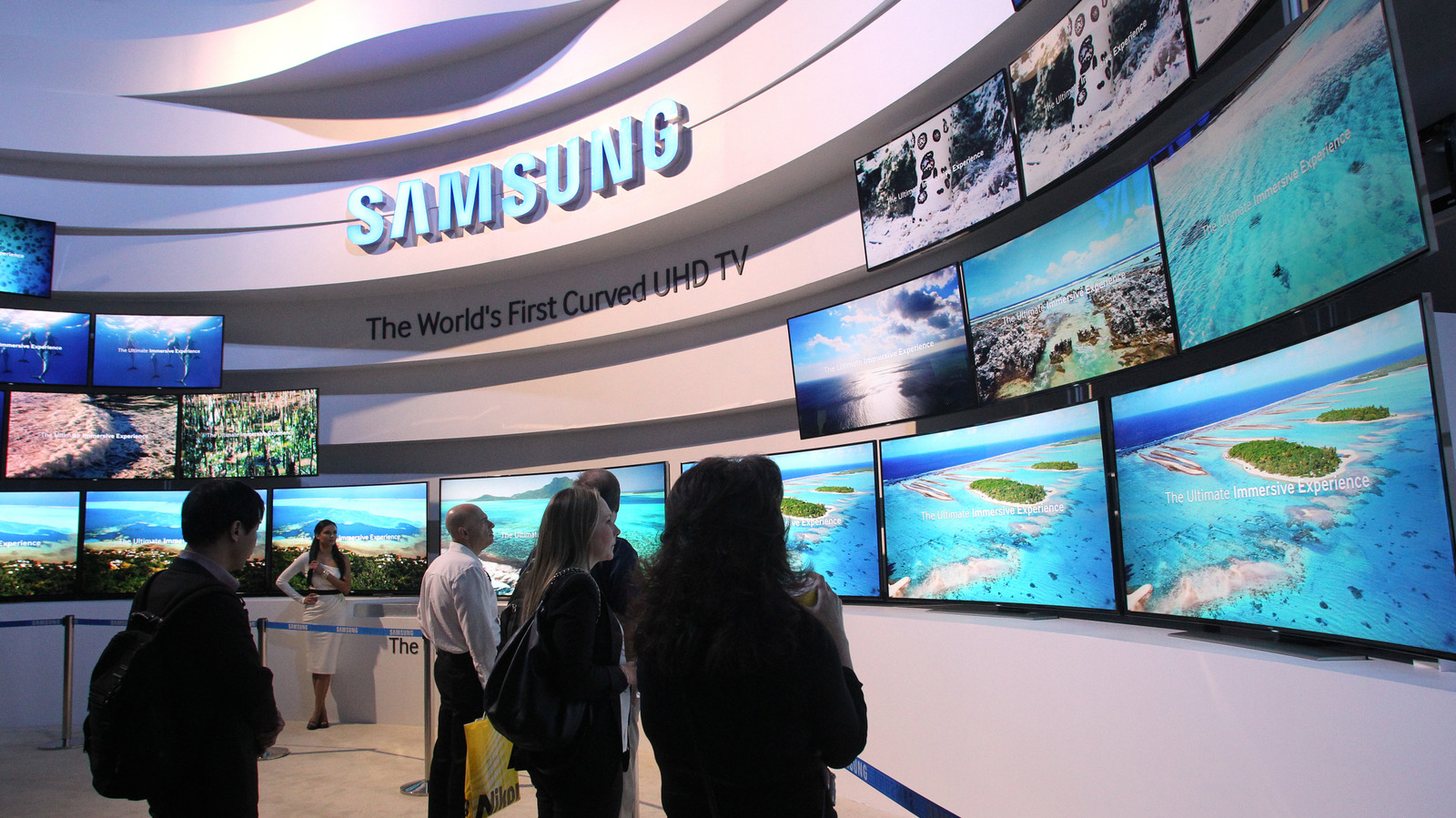
Curved TVs were a notable trend throughout the 2010s, often marketed as a more immersive way to watch content. Like 3D sets, they eventually faded: by 2020 even Samsung, the last major holdout, stopped producing them. Today, curved televisions are effectively dead outside of a few concept models, but the underlying idea lives on in gaming monitors, which offer even more extreme curvature.
Why immersion fell short Large curved screens have long worked in venues like IMAX theaters or the Cinerama Dome, where viewers sit close to massive concave displays. That effect does not translate to a 55- to 65-inch TV positioned six to ten feet away in a living room. Unless you had an unusually large 78-inch curved set and sat relatively near it, the theatrical sense of immersion was hard to reproduce. Everyday surroundings—decorations, family photos, pets—further disrupted the illusion.
Off-angle viewing problems Curved LCD panels had a narrow sweet spot directly in the center. Move away from that position and contrast and color saturation dropped noticeably. Dark scenes, such as those in Game of Thrones, became difficult to parse when viewed off-center. Curved OLED TVs did not suffer the same sweet spot issue, but they were typically more expensive than flat OLEDs. Engadget's own observations at CES demos confirmed that vibrant films could appear almost greyscale at extreme angles.
Manufacturing and wall-mounting hurdles Dipin Sehdev, founder and CEO of consumer electronics aggregator CE Critic, said in an interview that manufacturers found curved TVs difficult to produce at scale. While smaller sizes like 30 to 32 inches were manageable, 55, 65, or 75-inch curved panels were challenging to manufacture and ship while maintaining uniformity. Even large companies could only absorb such production losses for so long. Wall mounting added another problem: as flat screens became slimmer, consumers wanted to hang them above fireplaces for a clean look. According to Sehdev, some curved TVs had corners that protruded up to six inches, making a contemporary wall-mounted setup awkward.
Why gaming monitors succeeded Curved gaming monitors took off because they serve a single user who sits close. In that context, the central viewing sweet spot is a feature, not a bug. A 27- or 32-inch curved screen can feel genuinely immersive compared to a distant 65-inch TV. There is also a practical benefit: the curve brings more of the screen into direct view, reducing the need to crane your neck to see far edges. This is especially useful in online shooters, where quickly spotting someone flanking you can mean the difference between victory and defeat.
Extreme ultrawide monitors, such as Alienware's 34-inch ultrawide or Samsung's 55-inch Odyssey Ark, would be far less usable if completely flat. Sehdev added that as consumers adopt simulation games like Gran Turismo or Microsoft Flight Simulator, demand for curved screens in those experiences continues to grow.
Conclusion Curved TVs were largely a marketing gimmick at a time when companies were desperate to sell new sets. Yet the experience of making those televisions helped manufacturers develop curved gaming monitors that consumers actually want—a rare case where a failed product category laid the groundwork for a successful one.
See an error? Read our corrections policy or email [email protected].